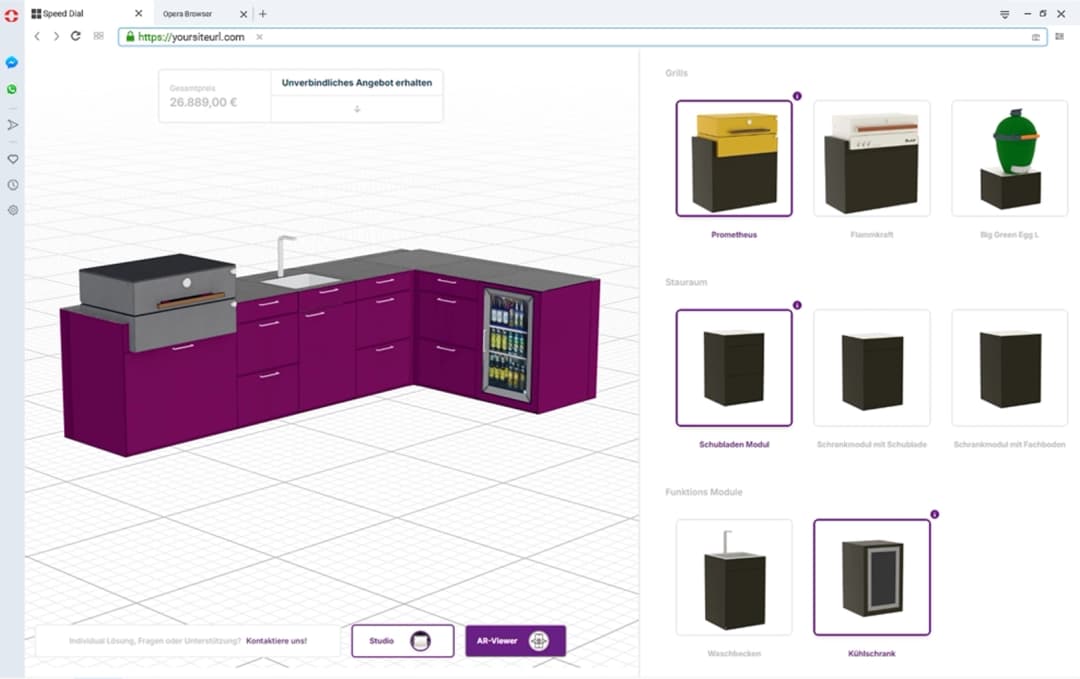



What is a product configurator?
A product configurator is software that lets buyers or sales teams build a valid product by choosing options—materials, sizes, modules, accessories, and pricing—while rules keep every combination manufacturable. Modern platforms add interactive 3D visualization, guided selling, and CPQ so customers see exactly what they are ordering and teams quote faster with fewer errors.
In short: instead of browsing a static catalog and hoping the order is right, users configure a product interactively and leave with a complete, sellable build.
Why product configurators matter
Configurable products create value for buyers and complexity for sellers. A sofa with dozens of fabrics, a machine with dependent accessories, or a custom apparel line with print constraints can generate thousands of combinations. Without a configurator, that complexity shows up as:
- Long email threads and spreadsheet quotes
- Invalid option mixes that fail in production
- Slow sales cycles for high-consideration purchases
- Higher return rates when customers cannot visualize the final product
A product configurator turns those combinations into a guided experience. Shoppers explore options with confidence. Sales teams quote accurately. Operations receive cleaner orders.
Core capabilities of a modern product configurator
Option selection and product rules
At minimum, a configurator presents options and enforces compatibility. If a frame only supports certain tops, invalid choices are hidden or blocked. Rule-based logic is what separates a real configurator from a simple variant picker.
3D visualization
Interactive 3D helps buyers understand materials, proportions, and finishes in real time. Photorealistic rendering reduces uncertainty that static photos cannot resolve—especially for furniture, equipment, jewelry, and modular products.
Guided selling
Guided selling sequences questions and options so complex catalogs feel approachable. Instead of dumping every attribute at once, the flow adapts to what the buyer already chose.
Configure, price, quote (CPQ)
As options change, pricing updates live. Sales teams can generate branded quotes with configuration summaries instead of rebuilding line items by hand. Learn more about CPQ software and how it pairs with visualization.
Ecommerce and ERP integrations
Configured products need a path into cart, CRM, or ERP. Integrations with platforms like Shopify, WooCommerce, Magento, Zoho, and Odoo keep storefront selling connected to operations.
Production outputs
Advanced configurators export BOMs, dimensions, drawings, or print-ready files so manufacturing does not restart from a vague order description.
Types of product configurators
Ecommerce / D2C configurators
Embedded on product pages so shoppers customize and add to cart. Common for furniture, apparel, jewelry, and made-to-order goods.
B2B / CPQ configurators
Used by sales teams and dealers to configure complex products, apply commercial rules, and issue quotes. Often paired with approval workflows.
Industry-specific configurators
Examples include workstation configurators, kitchen planners, apparel design tools, and vehicle builders. The shared pattern is the same: visualize, validate, price, and hand off.
Product configurator vs product customizer vs CPQ
These terms overlap, but they are not identical:
| Term | Focus |
|---|---|
| Product customizer | Often emphasizes visual personalization (colors, text, artwork) |
| Product configurator | Emphasizes valid combinations, rules, and complete builds |
| CPQ | Emphasizes pricing, quoting, and commercial workflows |
Many modern platforms combine all three: customers configure visually, rules keep builds valid, and CPQ handles price and quote.
Who should use a product configurator?
Product configurators are a strong fit when:
- Your catalog has dependent options or modular assemblies
- Buyers struggle to imagine the final product from photos alone
- Sales spends too much time on manual quoting
- Invalid orders create remakes, returns, or engineering bottlenecks
- You sell through ecommerce, dealers, or both
Industries that commonly benefit include furniture, manufacturing, custom apparel, kitchen and bath, automotive accessories, jewelry, and building materials.
How to choose product configurator software
When evaluating solutions, look beyond demos and ask:
- Can rules encode your real constraints? Pretty 3D without manufacturable logic creates bad orders.
- Does pricing stay accurate as options change? Live CPQ matters for complex catalogs.
- Where does the configuration go next? Cart, quote, CRM, ERP, and production outputs should be clear.
- How fast can your team maintain the catalog? Non-technical updates reduce long-term cost.
- Will shoppers use it on mobile? Browser-based experiences without app installs win more adoption.
If you are comparing tools, start with our commercial overview of product configurator software and the buyer guide to choosing the best product configurator software. Related reads: product customizer and sales configurator.
How Konfigear approaches product configuration
Konfigear product configurator software combines interactive 3D, guided selling, CPQ, AR previews, and ecommerce integrations in one platform. Brands can let customers configure products online, keep every build valid, and sync configured orders into the systems they already use. For visualization-first experiences, see the 3D product configurator.
Whether you sell furniture, industrial equipment, apparel, or custom goods, the goal is the same: turn configuration complexity into a buying experience that converts.
Frequently asked questions
What is a product configurator in simple terms?
It is software that helps someone build a custom product step by step, shows what the product looks like, keeps choices valid, and calculates the correct price.
Do product configurators only work for ecommerce?
No. Many manufacturers use configurators for dealer portals, sales demos, and internal quoting even when buyers are not self-serving on a public storefront.
Is a 3D product configurator required?
Not always—but 3D and AR dramatically improve understanding for visual or spatial products. Rule-based configuration and CPQ can still deliver value without photorealistic rendering.
How long does implementation take?
Timelines depend on catalog complexity, 3D assets, pricing rules, and integrations. Most teams start with a high-impact product family, then expand.
Next steps
If you are exploring product configuration for ecommerce or manufacturing:
- Review product configurator software
- Explore the 3D product configurator
- Explore guided selling for complex catalogs
- Request a demo to see Konfigear on your product line